

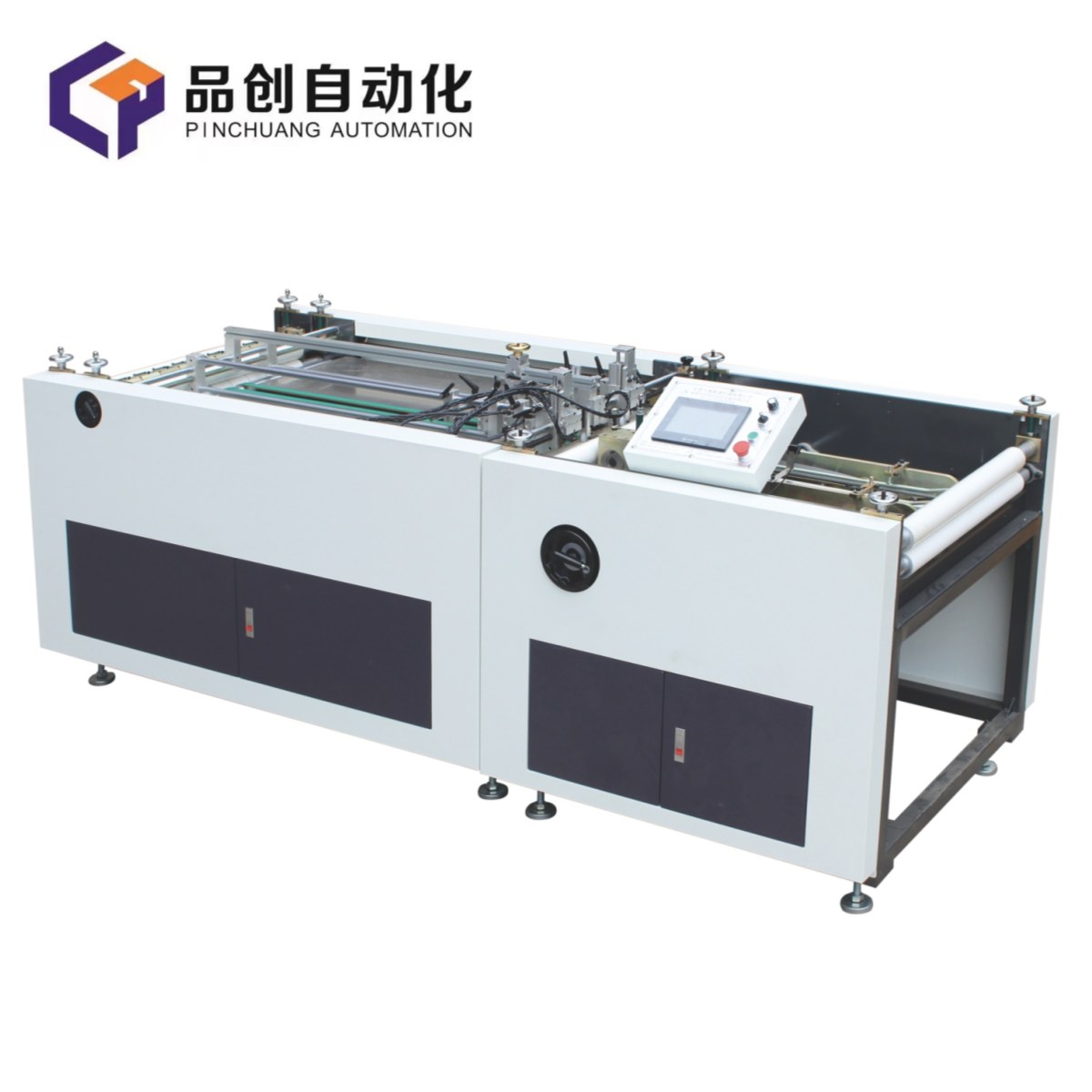
A hard cover making machine glues a printed wrap to greyboard and turns the edges in to produce a finished book case — front board, back board and the spine gap between them. It does not print and it does not bind; it takes printed sheets and board and delivers a stiff, wrapped cover that a binder then marries to the book block.
At Pinchuang, hard cover equipment sits between our case making and rigid box platforms, and buyers often arrive with the same question: is a hard cover making machine a book machine or a packaging machine? The answer is that the mechanics are shared and only the settings change. This guide explains what the machine produces, how the stations in a hard cover line divide the work, how book covers differ from premium box cases, and the quality checks that decide whether a finished cover looks professional or merely acceptable.
What a Hard Cover Making Machine Actually Produces
Every hard cover is built from three elements, and the machine's job is to bring them together with the right gaps and the right tension.
- Boards. Two rigid boards, called the front and back case boards, cut slightly larger than the trimmed book block. Board thickness typically runs from about 1.2 mm to 4 mm, and the choice is driven by book bulk rather than by looks.
- The spine strip. A narrow board between the two covers, separated by a gap that becomes the hinge. That gap is the single most important dimension on the whole product: too tight and the book will not open, too loose and the spine looks cracked after a week of handling.
- The wrap. Printed cover paper, often laminated or textured, glued across the board assembly and turned in around all four edges with a small turn-in allowance for the inside of the cover.
The output is a flat, finished case. It is not a box and it is not a bound book. Buyers who expect a single machine to take printed sheets in one end and finished books out the other are usually confusing a case making machine with a binding line, and the confusion costs them time when they plan capacity.
The Stations in a Hard Cover Line
A hard cover line is a short sequence, and most plants buy it in stages rather than as one purchase. Understanding which station does what makes it much easier to decide where to start.
Gluing
Where the printed wrap picks up an even film of adhesive. On a large cover this is the station that decides whether the finished case lies flat, because a film that varies across the sheet pulls the board unevenly as the moisture equalises. A dedicated paper gluing machine feeding the line is often the difference between a stable cover and one that curls at the corners.
Case making
The boards are positioned on the glued wrap and the paper is turned in around them. This is the station that sets the spine gap, and on our case making platform the minimum middle strip is 10 mm with support for up to six separated board pieces in one assembly — enough for multi-part covers and for stationery products that use the same construction.
Four-side wrapping and pressing
Turning in on all four edges at once is what separates a hard cover machine from a plain gluing and assembling station. The PC-900 four side wrapping machine takes the assembled board, folds the wrap over every edge and presses the result flat, running at 20–30 units/min across covers from L 150 × W 90 mm to L 1000 × W 500 mm. The specification card further down this page sets out its full working range.
Assembly of cover to block
Further downstream, a separate station mates the finished case with the book block, and the same class of machine also handles rigid box assembly work. That is the step most often confused with hard cover making, and keeping the two separate in your planning is the simplest way to avoid buying the wrong capacity.
Book Covers vs Premium Box Cases: Same Machines, Different Settings
A plant that makes both books and luxury packaging does not need two complete equipment sets. It needs two recipes on a shared platform.
| Setting | Book cover | Premium box case |
|---|---|---|
| Spine gap | Mandatory, sized to book bulk | Usually absent or decoratively scored |
| Wrap weight | 100–250 g/m², often laminated | Wider range, heavier decoration |
| Board thickness | Chosen to match book bulk | Chosen for rigidity and feel |
| Edge condition | Turn-in hidden inside the cover | Turn-in often visible on a tray |
| Next station | Cover-to-block assembly | Forming into a three-dimensional box |
The practical consequence is that the same platform serves both products, and the decision to run one or the other is a tooling and settings decision rather than a second machine purchase. Pinchuang builds a combined configuration, the PC-5010D, for plants that genuinely need rigid box and hardcover output on one frame.
Book Cover Quality Checks That Matter
Three checks catch almost every defect a hard cover machine can produce. All three can be done by hand on the shop floor, and all three should be done on the first piece of every run.
Spine
Open and close the finished case several times and watch the hinge. The spine should bend as a curve, not crease along a line. Movement that concentrates in one spot means the gap is wrong or the board is too thick for the cover size, and it will show as a cracked spine on the shelf.
Squareness
Measure both diagonals. A cover that is out of square by even a millimetre will not sit flush against a book block, and the error compounds when the block is inserted. On patterned and branded covers this is also where a visual positioning system earns its place: our Yamaha-equipped configurations hold ±0.1 mm, against around ±0.50 mm for mechanical referencing.
Wrap tension
Run a thumb along the turn-in on all four edges. It should feel tight and even, with no wave in the middle of an edge. Movement noticed at this stage almost always grows in transit, because a wrap that is slightly loose when it leaves the machine will relax further in a humid warehouse.
Building This Equipment in Practice
Pinchuang has been manufacturing case making, hard cover and rigid box equipment in Dongguan since 2008. Production runs from a 10,000 m² facility with more than 100 employees, and the machines ship to over 30 countries. We exhibit at All in Print China, Printing South China, China Print, Drupa, SINO FOLDING CARTON and WEPACK.
That matters to hard cover buyers for one specific reason: the machine has to be configured around your cover sizes before it is built, not after. Cover range, board thickness, spine gap and whether you need visual positioning are all fixed at order stage. Looking at how these configurations are used in practice on the applications page is a fast way to see which version matches your product mix.


Common Questions About Hard Cover Production
Does a hard cover making machine also bind books?
No. It produces the finished case only. Binding the book block, rounding the spine and inserting the block into the case are separate operations. Plants that run both usually keep hard cover making and binding as two departments with different capacity, because the two run at different speeds.
Can one machine make both book covers and box cases?
Mechanically yes, and we build a combined platform for exactly that requirement. The differences are in tooling and settings: a book cover needs a controlled spine gap and a cover-to-block pairing afterwards, while a box case needs a wrap that will survive forming. If more than one product family runs on the same machine, plan changeover time into your weekly schedule rather than treating it as free.
Do I need vision positioning for book covers?
Only when the cover carries a printed design that has to land in a fixed position. Plain cloth, solid colours and simple textures can be located mechanically and hold around ±0.50 mm. Printed borders, logos and designs that continue across the spine benefit from the ±0.1 mm achievable with a visual positioning unit reading printed marks.
Why do covers come back with wavy edges?
Almost always moisture rather than the wrapping. Glue carries water into the paper, and if the film is uneven or the cover is stacked while still warm, the paper expands and then contracts at a different rate from the board. Check glue film and stacking first, then the storage room, before touching machine settings.
Send Pinchuang your cover sizes, board thickness and a sample of the wrap you intend to use. We will tell you which hard cover making machine covers your range, and whether the spine gap needs special tooling.
Send us a cover sample Check every hard cover model